Today we headed out early for the long drive to Maseru. The trip in total took 5 and a half hours and was 257 miles (414km) long. We stopped for lunch before getting into Lesotho at the Cranberry Cottage in Ladybrand, South Africa. Cranberry Cottage is a large bed and breakfast/restaurant. We hung out with the ducks and peahen and then headed into Lesotho.
Once we crossed into Lesotho, we headed to the Habitat Lesotho office for orientation.
We learned about the family we will be building for. Tumisang Moshao is a 17 year old orphan. He has lived with his uncle Beleme Matekane since his mother passed in 2005. His father passed away before he was born. Tumisang's parents never owned property or a house. The current living situation has the 2 men living in a 1 room stone house with no windows.
Tumiseng has only completed schooling through grade 7, with his teachers suggesting a trade school, so he can learn skills to get a job.
We will be building a 2 room house for the family over the course of the week. The job starts tomorrow with hand mixing the cement for the floor pad.
Habitat for Humanity brings people together to build homes, communities and hope. St. Vrain Habitat for Humanity supports and builds with its partners around the world.
Monday, April 1, 2019
Sunday, March 31, 2019
Day 1: Johannesburg and Soweto
First off, We're here! We have arrived safe and sound in South Africa. Here is a picture of most of the team upon arriving in Johannesburg.
Today, most of the team took part in a tour of Johannesburg and Soweto. We first went to the Mining District, which showcased pieces of South African mining equipment and also street art.
We then went to Constitution Hill, which was a fort built by Paul Kruger to defend the South African Republic from British invasion. It was later renovated into a prison, both Mahatma Ghandi and Nelson Mandela were held here. A link to the website can be found here.
We then headed to Soweto, where Nelson Mandela and Desmond Tutu lived. We toured Nelson Mandela's house, then headed to the Hector Pieterson Memorial.
Hector Pieterson was the youngest person killed in the Soweto Uprising in 1976. To learn more about this event, click here.
Tomorrow morning, we head to Maseru, Lesotho by bus. The drive is expected to take approximately 6 hours with a break for lunch. We will meet the Habitat staff and have orientation, with the building to start on Tuesday.
Today, most of the team took part in a tour of Johannesburg and Soweto. We first went to the Mining District, which showcased pieces of South African mining equipment and also street art.
We then headed to Soweto, where Nelson Mandela and Desmond Tutu lived. We toured Nelson Mandela's house, then headed to the Hector Pieterson Memorial.
Tomorrow morning, we head to Maseru, Lesotho by bus. The drive is expected to take approximately 6 hours with a break for lunch. We will meet the Habitat staff and have orientation, with the building to start on Tuesday.
Friday, March 29, 2019
On the way to Johannesburg!
On Saturday, March 30th, the team will be landing in Johannesburg for a brief respite before heading to Maseru on April 1st. We will be taking a scenic 6 hour drive across South Africa, with a stop in the middle for lunch. We look forward to starting our work with our Lesotho partners and seeing where the week leads us.
Sunday, September 9, 2018
Day 7 - Last day at Norogi and a visit to Warm Hearth
Today was our last day in Armenia. We started our day with a stop at the Norogi Resource center to finish up our projects of the week. We have been painting children' chairs and panting tea trays that were made with laminate floor remnants.
The plan is to sell the tea trays for 1000-1500 ($2-3 USD) dram a piece to help raise money for Habitat Armenia's projects. To follow along with Habitat Armenia, click here.
We then headed over to Warm Hearth, which is the first group home in Armenia for people with special needs that have aged out of the orphanages. They opened in 2006 and currently house 14 people at this location with a second location with 8 more people. We were shown their house that includes administrative offices, therapy rooms and places were they can hand make rugs and pottery projects.
This specific group of people have been together most of their lives, having been from the same orphanage. It is great that they are able to stay together and remain a family unit. To learn more about Warm Hearth, please visit their website here.
Day 6 - Etchmiadzin, St. Hripsime, Lake Sevan and a reunion
Today we started out with a trip up to Etchmiadzin, which is where the first Christian church was built in 301 A.D. It is known as the "Armenian Vatican." We toured the grounds and saw as much as we could. The alter and front rows of the church were under renovation.
We then stopped at the church of St. Hripsime, which was on our way to Lake Sevan. St Hripsime church was built to honor the memory of one of the first Christian Martyrs. It is one of the oldest surviving churches n Armenia, having been built in 618 A.D.
We then headed east to Lake Sevan, which also houses the monastery complex of Sevanavank. Lake Sevan one of the largest freshwater lakes in Eurasia.
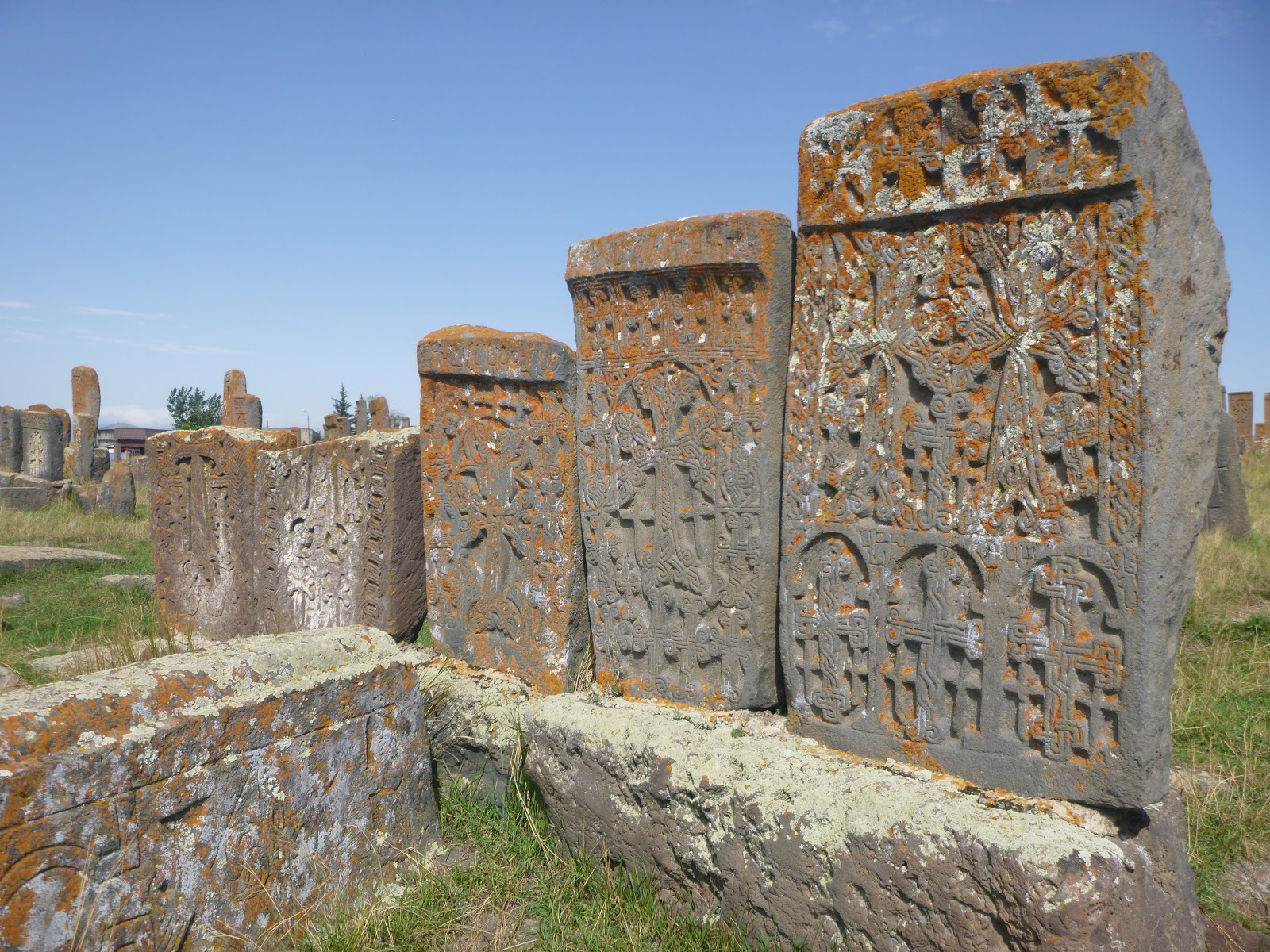
We then stopped at the Noratus cemetery, which houses the largest collection of khachkars (cross stones) in Armenia.
After a short walk through the cemetery, we took a short drive to visit Yura Hovhannisyan's family, whose house we worked on in 2015. They had finished up the bathroom about a month after we left, and then completed the drainage system. They finished the kitchen as well and put in a patio last year. Unfortunately, Yura had passed away since we were there last.
We then stopped at the church of St. Hripsime, which was on our way to Lake Sevan. St Hripsime church was built to honor the memory of one of the first Christian Martyrs. It is one of the oldest surviving churches n Armenia, having been built in 618 A.D.
We then headed east to Lake Sevan, which also houses the monastery complex of Sevanavank. Lake Sevan one of the largest freshwater lakes in Eurasia.
We then stopped at the Noratus cemetery, which houses the largest collection of khachkars (cross stones) in Armenia.
After a short walk through the cemetery, we took a short drive to visit Yura Hovhannisyan's family, whose house we worked on in 2015. They had finished up the bathroom about a month after we left, and then completed the drainage system. They finished the kitchen as well and put in a patio last year. Unfortunately, Yura had passed away since we were there last.
Here is a photo of the outside of the old kitchen, that was detached from the house.
Here is the old toilet (outhouse).
Saturday, September 1, 2018
Day 5- Spitak and Vanadzor
Today we drove about an hour north of Yerevan to the town of Spitak to see the work that Habitat has done in the area. We stopped at a building that was part of a project that fixed windows, front doors, roof and drainage of 12 buildings.
Most of the buildings that were affected by the earthquake in 1988 have been replaced or repaired, but there are still some people living in shipping containers. Here is an example of what a shipping container that has been upgraded looks like from the outside.
We also drove of to an area that was full of small fiberglass houses that had been donated by Italy to help with the housing situation right after the earthquake.
We then drove about an hour south east to visit a couple of social enterprises located in Vanazdor. The first one was EREO, a non-profit, which stands for Equal Rights, Equal Opportunities. Their mission is to provide training for people with disabilities to be able to work and create handmade crafts. EREO was given a grant from the European Union to obtain equipment such as sewing machines and stamping machines for printing on glasses. The Lory area has the highest percentage of disabled people, in large part because of the of lasting effects of the injuries from the 1988 earthquake.
We then headed to another social enterprise nearby, called the Apricot company, a for-profit. They also employ people with disabilities to make crafts to be sold in the tourist areas such as Yerevan and Garni. They have a total of 36 people that they employ, and their crafts range from wooden refrigerator magnets to tea filled wooden boxes. They also have contracts to produce cloth for buyers in the region.
Most of the buildings that were affected by the earthquake in 1988 have been replaced or repaired, but there are still some people living in shipping containers. Here is an example of what a shipping container that has been upgraded looks like from the outside.
We also drove of to an area that was full of small fiberglass houses that had been donated by Italy to help with the housing situation right after the earthquake.
We then drove about an hour south east to visit a couple of social enterprises located in Vanazdor. The first one was EREO, a non-profit, which stands for Equal Rights, Equal Opportunities. Their mission is to provide training for people with disabilities to be able to work and create handmade crafts. EREO was given a grant from the European Union to obtain equipment such as sewing machines and stamping machines for printing on glasses. The Lory area has the highest percentage of disabled people, in large part because of the of lasting effects of the injuries from the 1988 earthquake.
We then headed to another social enterprise nearby, called the Apricot company, a for-profit. They also employ people with disabilities to make crafts to be sold in the tourist areas such as Yerevan and Garni. They have a total of 36 people that they employ, and their crafts range from wooden refrigerator magnets to tea filled wooden boxes. They also have contracts to produce cloth for buyers in the region.
Subscribe to:
Posts (Atom)